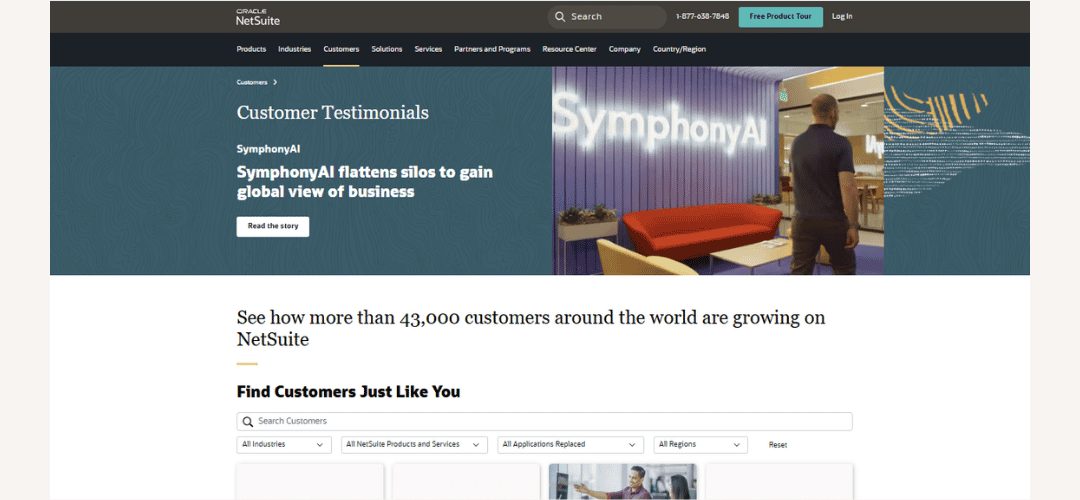
Oracle NetSuite Review is the world’s most widely adopted cloud ERP for mid-market businesses. It unifies financial management, CRM, inventory, HR, and eCommerce into a single platform — replacing multiple disconnected tools with one source of truth accessible in real time from anywhere.
Founded in 1998 and acquired by Oracle in 2016 for $9.3 billion, NetSuite is trusted by over 37,000 businesses across 200+ countries. This review gives you a clear, honest picture of what it delivers, what it truly costs, and when it makes sense — and when a lighter alternative is the smarter move.
Quick Summary
| Category | Details | Rating |
|---|---|---|
| Overall | Mid-market to enterprise cloud ERP leader | ★★★★☆ 4.0 / 5.0 |
| Best For | Multi-entity & enterprise businesses | — |
| Pricing | Custom quote — starts ~$999+/month | ★★★☆☆ 3.0 / 5.0 |
| Free Trial | Not available | — |
| Deployment | 100% cloud-based SaaS | — |
| Features | All-in-one ERP, highly customizable | ★★★★★ 5.0 / 5.0 |
| Ease of Use | Steep learning curve, dated interface | ★★★☆☆ 3.0 / 5.0 |
| Customer Support | Partner network; 24/7 via Premium plan | ★★★★☆ 4.0 / 5.0 |
| Implementation | 3–18 months; certified partner required | ★★★☆☆ 3.0 / 5.0 |
| Security | SOC 2, ISO 27001, GDPR, PCI DSS compliant | ★★★★★ 5.0 / 5.0 |
What Is NetSuite?
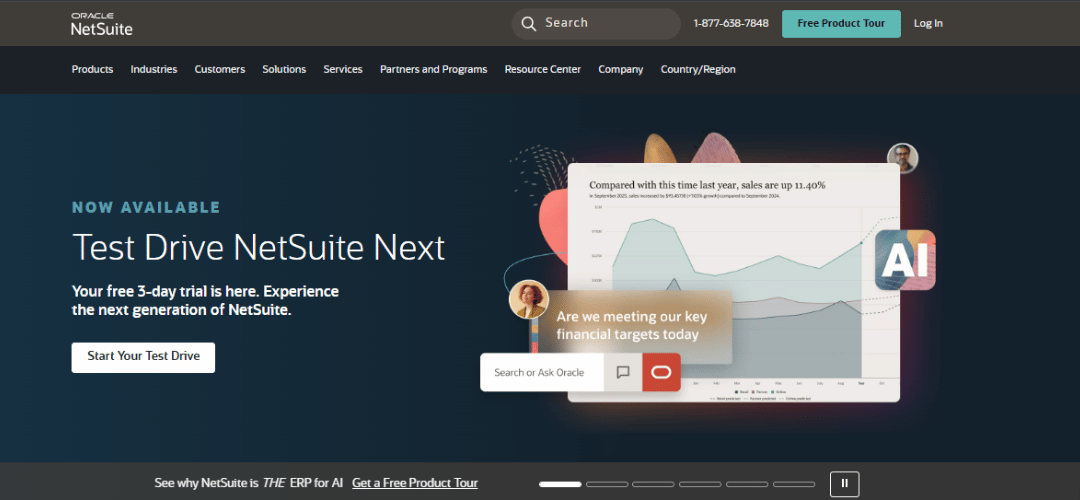
Oracle NetSuite Review is a cloud-based ERP platform that combines financial management, CRM, inventory, HR, and eCommerce into one unified system. Acquired by Oracle in 2016 for $9.3 billion, it is trusted by over 37,000 businesses across 200+ countries and is the most widely adopted mid-market cloud ERP globally.
Who It’s Best For
- Mid-market & enterprise — companies with complex, multi-department operations that have outgrown basic accounting tools
- Multi-entity & global businesses — needing consolidated financial reporting across subsidiaries and currencies
- SaaS, manufacturing, retail & eCommerce — teams requiring a single operational and financial source of truth
- IPO-stage companies — requiring enterprise-grade financial infrastructure and clean audit trails
Company Size Fit
| Company Size | Fit | Notes |
|---|---|---|
| Small Business (< 50 employees) | Poor | Overpowered and expensive for simple needs |
| Mid-Market (50–500 employees) | Excellent | Core target audience; strongest ROI here |
| Enterprise (500+ employees) | Strong | Multi-entity and global operations |
| IPO-Stage Tech Companies | Excellent | Proven audit-ready financial infrastructure |
Time to Change: Where NetSuite Feels Heavy for Modern Teams
As businesses scale rapidly, NetSuite’s compliance-first architecture often becomes a bottleneck rather than an enabler. Rigid approval workflows, complex configuration requirements, and high administrative overhead slow down fast-moving teams. Companies increasingly find lighter, more agile alternatives better suited to their pace — until operations genuinely demand NetSuite’s full ERP depth.
Key Features
NetSuite brings together eight business systems that would otherwise require separate software and constant manual syncing. Here is what each core module delivers and why it matters for your team.
Accounting & Financial Management
NetSuite’s financial module handles complex multi-entity consolidations with full audit trails and automated close workflows. Multi-currency support with automated foreign-exchange calculations eliminates manual reconciliation for global finance teams
Inventory & Supply Chain Management
Real-time stock tracking with automated reorder triggers, end-to-end order fulfilment workflows, MRP, and production planning — all connected directly to financial reporting. Essential for manufacturers, distributors, and multi-location retailers managing complex supply chains.
CRM & Customer Management
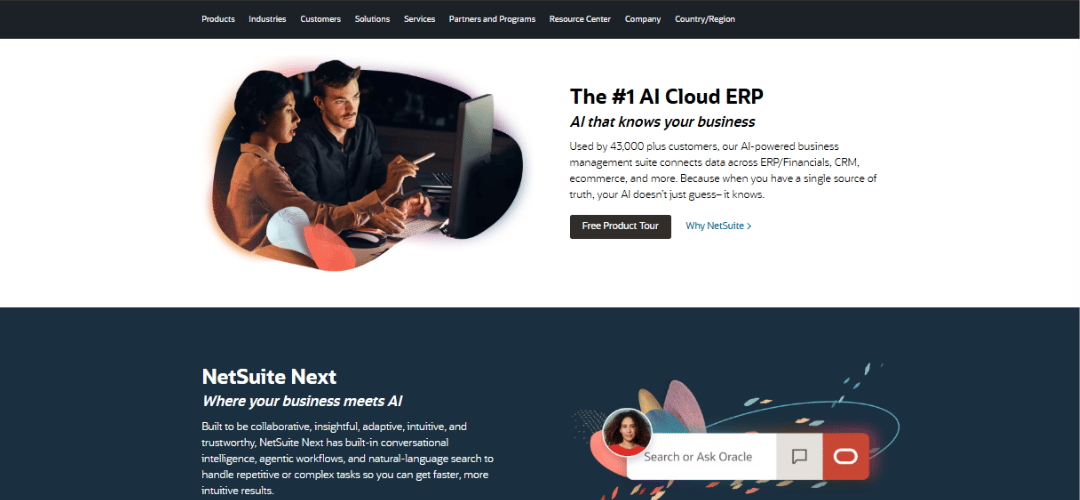
The Customer 360 view links sales records with billing history, support tickets, and fulfilment data — context that standalone CRMs like Salesforce lack. Sales pipeline tracking connects directly to financial projections, giving leadership a unified revenue and cash flow view in real time.
SuiteCommerce & eCommerce
B2B and B2C storefront management with Amazon and Shopify integrations that push order data directly into fulfilment and finance workflows. This removes the manual syncing that causes costly errors in disconnected retail tech stacks.
Analytics & Reporting
Role-based dashboards via SuiteAnalytics give each department relevant KPIs without IT involvement. Non-technical users can build custom data queries using saved searches — no SQL required. 973+ pre-built integrations extend NetSuite’s reach across virtually any existing tech stack.
NetSuite Pricing 2026
NetSuite does not publish pricing. All quotes are custom, factoring in user count, modules selected, storage, and contract length. This lack of transparency is one of the most frequently cited buyer frustrations during the evaluation process.
Primary Cost Components
| Cost Component | Estimated Range |
|---|---|
| Base License (Annual) | $10,000 – $50,000+ |
| Per User License | $99 – $199 / user / month |
| Add-On Modules | $500 – $5,000+ / month each |
| Implementation Partner | $25,000 – $150,000+ |
| Annual Maintenance & Support | ~20% of annual license fee |
Hidden Total Cost of Ownership
- Dedicated administrator salary — $70,000 to $110,000 per year for a qualified NetSuite admin
- Ongoing customization costs — for workflow changes and evolving business processes over time
- Annual retraining — as staff turns over and system processes continue to evolve
- Consulting partner fees — for upgrades, new module deployments, and ongoing troubleshooting
Pros & Cons
| ✔ Strengths | ✘ Weaknesses |
|---|---|
| All-in-one ERP — replaces multiple tools with one system of record | High total cost — TCO commonly $50,000 – $200,000+/year |
| Highly customizable — SuiteScript, SuiteFlow, SuiteBuilder for deep tailoring | Complex implementation — $25,000 – $150,000+ in partner fees alone |
| 973+ integrations — connects to virtually any existing tech stack | Steep learning curve — weeks of training before users feel comfortable |
| IPO-ready infrastructure — proven audit-ready financial controls | Outdated UI — interface lags behind modern SaaS competitors |
| Strong real-time reporting — role-based dashboards across all modules | Requires dedicated admin — essential for any meaningful deployment |
| Global scalability — multi-currency, multi-entity, multi-language support | Heavy for startups — too rigid for fast-moving, agile environments |
Best Alternatives
QuickBooks
QuickBooks is the leading accounting solution for small businesses and freelancers. Starting at ~$30/month, it offers invoicing, payroll, expense tracking, and basic inventory. It cannot match NetSuite’s multi-entity reporting or ERP depth.
SAP Analytics Cloud
SAP Analytics Cloud focuses on business intelligence, planning, and predictive analytics rather than full ERP operations. It is best suited for enterprise teams needing advanced scenario modeling and data visualization layered on top of an existing ERP system, rather than replacing one.
SAP Business One
SAP Business One is a purpose-built ERP for SMBs in manufacturing and distribution. It offers strong production planning, multi-warehouse management, and financial consolidation. Custom-quoted pricing and SAP’s certified partner network make it a credible NetSuite alternative for mid-size manufacturers seeking proven ERP depth.
Sage Intacct
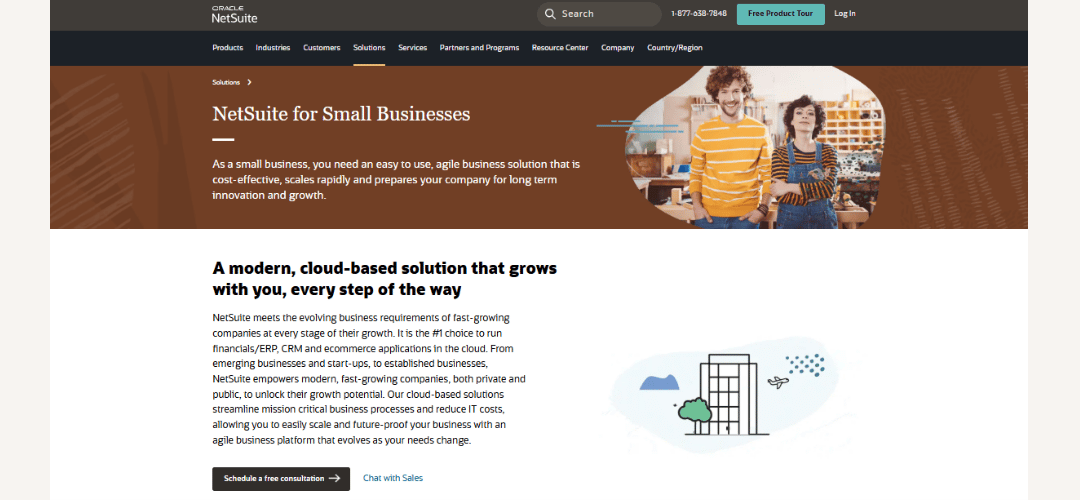
Sage Intacct is the strongest mid-market alternative to NetSuite for finance-first organizations. Starting at ~$400/month, it delivers GAAP-compliant multi-entity accounting, dimensional reporting, and strong audit trails. It lacks NetSuite’s full ERP breadth but outperforms it on financial reporting flexibility and ease of use.
Xero
Xero is a cloud accounting platform starting at ~$15/month, ideal for small businesses and accountants. It offers clean invoicing, bank reconciliation, payroll, and a strong app ecosystem. Xero cannot handle multi-entity consolidation or complex inventory.
Odoo
Odoo is an open-source modular ERP starting free (Community) to $24/user/month (Enterprise). It covers accounting, CRM, inventory, HR, manufacturing, and eCommerce in one platform. Highly customizable through its module marketplace, Odoo is the most compelling budget-friendly NetSuite alternative for growing SMBs willing to invest in technical setup.
FreshBooks
FreshBooks is a cloud accounting tool designed for freelancers and small service businesses, starting at ~$19/month. It excels at invoicing, time tracking, and expense management. It is not an ERP and cannot scale to NetSuite’s complexity, but for solo operators and small teams, it is intuitive and cost-effective.
Microsoft Dynamics 365
Microsoft Dynamics 365 is an enterprise ERP and CRM suite starting at ~$70/user/month. It integrates deeply with Microsoft 365, Power BI, and Azure, making it ideal for organizations already in the Microsoft ecosystem. It matches NetSuite’s enterprise depth and often wins on UI modernity and analytics capability.
Fuelfinance
Fuelfinance is a financial planning and analysis (FP&A) tool built specifically for startups and scale-ups. It focuses on budgeting, forecasting, and financial modeling rather than full ERP operations. It is best used alongside an accounting tool like Xero or QuickBooks, not as a standalone NetSuite replacement.
Lark
Lark is a collaborative workspace platform combining messaging, video, documents, and lightweight workflow tools. While not an ERP, it enables operational coordination and basic process management for fast-growing teams. It works as a complementary layer to accounting tools but cannot replace NetSuite’s financial management or operational depth.
Alternatives Comparison Table
| Tool | Best For | Starting Price | Key Strength |
|---|---|---|---|
| QuickBooks | Small businesses | ~$30/month | Simple, affordable accounting |
| Sage Intacct | Mid-market finance | ~$400/month | GAAP-compliant accounting |
| Xero | Small businesses | ~$15/month | Easy cloud accounting |
| Odoo | Growing SMBs | Free – $24/user | Open-source modular ERP |
| MS Dynamics 365 | Enterprise | ~$70/user/month | Deep Microsoft 365 integration |
| SAP Business One | SMB manufacturing | Custom quote | Strong mid-market ERP |
| FreshBooks | Freelancers & SMBs | ~$19/month | Simple invoicing & billing |
NetSuite vs Competitors
NetSuite vs QuickBooks
NetSuite and QuickBooks serve fundamentally different business stages. QuickBooks is ideal for small businesses needing straightforward bookkeeping at ~$30/month. NetSuite is built for mid-market and enterprise organizations requiring multi-entity consolidation, ERP-level inventory, CRM integration, financial controls..
NetSuite vs SAP Business One
Both are strong mid-market ERP options, but NetSuite is cloud-native while SAP Business One supports both is preferred in DACH markets. NetSuite leads on global scalability, cloud infrastructure, and eCommerce integration for multi-entity SaaS and retail businesses.
NetSuite vs SAP Analytics Cloud
SAP Analytics Cloud is a BI and FP&A tool, not a full ERP. It complements existing systems with planning and forecasting rather than replacing operational ERP functions. NetSuite covers the full operational stack. Organizations needing both should evaluate SAP Analytics Cloud as a reporting layer on top of an ERP, not as a competing solution.
NetSuite vs Sage Intacct
Sage Intacct is the preferred NetSuite alternative for finance-first mid-market organizations. It delivers superior multi-entity accounting and dimensional reporting at a lower price and with easier implementation. NetSuite wins on full ERP breadth
NetSuite vs Xero
Xero is a small business accounting tool, not an ERP competitor. NetSuite handles multi-entity consolidation, advanced inventory, CRM, and full ERP operations at enterprise scale. Xero is the right choice for businesses under 50 employees. NetSuite becomes relevant when Xero’s limitations.
NetSuite vs Odoo
Odoo is the most direct open-source competitor to NetSuite for growing SMBs. It covers accounting, CRM, a fraction of NetSuite’s cost. NetSuite leads on enterprise scalability, audit readiness, and global compliance. Odoo wins on flexibility, affordability, and capable teams.
NetSuite vs Microsoft Dynamics 365
Microsoft Dynamics 365 is NetSuite’s closest enterprise competitor for organizations in the Microsoft ecosystem. Dynamics 365 offers deeper Power BI and Azure integration, a more modern UI, and stronger business intelligence.
NetSuite vs Fuelfinance
Fuelfinance is a lightweight FP&A tool for startup financial modeling and forecasting — not a full ERP. It does not compete directly with NetSuite’s operational and financial management depth.
NetSuite vs Lark
Lark is a collaboration and workflow platform, not an ERP. It does not offer accounting, inventory, or financial management capabilities. Lark can complement NetSuite or simpler accounting tools by handling team communication, document management, and lightweight process coordination
Full Competitor Comparison Table
| Product | Type | Best Market | Starting Price | Key Strength vs NetSuite |
|---|---|---|---|---|
| NetSuite | Full ERP | Mid-market / Enterprise | ~$999+/mo | — |
| QuickBooks | Accounting | Small business | ~$30/mo | Simpler, far cheaper |
| SAP Business One | ERP | SMB manufacturing | Custom | On-premise option, mfg depth |
| SAP Analytics Cloud | BI/FP&A | Enterprise | Custom | Advanced analytics layer |
| Sage Intacct | Accounting ERP | Mid-market finance | ~$400/mo | Better financial reporting |
| Xero | Accounting | Small business | ~$15/mo | Ease of use, low cost |
| Odoo | Modular ERP | Growing SMBs | Free–$24/user | Open-source, affordable |
| MS Dynamics 365 | ERP/CRM | Enterprise | ~$70/user/mo | Microsoft ecosystem depth |
| Fuelfinance | FP&A | Startups | Custom | Lightweight forecasting |
| Lark | Collaboration | Fast-growth teams | Free–varies | Agile collaboration |
Should You Switch to NetSuite?
Strong Signals to Move to NetSuite
- Outgrown QuickBooks, Xero, or FreshBooks — operations clearly exceed what basic accounting tools can handle
- Managing multiple legal entities — or operating across countries needing consolidated financial reporting
- 50+ employees — with dedicated finance and operations teams already in place
- Preparing for audit, Series B+, or IPO — requiring enterprise-grade financial controls and clean audit trails
Signs NetSuite Is Not the Right Fit
- Fewer than 50 employees — with straightforward operational and accounting requirements
- Budget under $50,000/year — unable to absorb a 3–6 month implementation and full annual TCO
- No dedicated admin or IT resource — available for ongoing maintenance, configuration, and user support
- Fast-moving startup environment — needing agility and simplicity over structured, compliance-first ERP workflows
Implementation & Customization
Implementation is the most underestimated aspect of any NetSuite deployment. Getting it right requires careful planning, dedicated internal resources, and realistic expectations about time and total budget.
Typical Timeline
- 3 – 6 months — standard mid-market deployments with moderate operational complexity
- 9 – 18 months — complex multi-entity or international rollouts with significant data migration
- Rushed implementations — are the single leading cause of poor post-go-live outcomes across all user reviews
Key Implementation Risks
- Scope creep — leading to delayed timelines and serious budget overruns on most projects
- Insufficient internal ownership — resulting in poor user adoption and low ROI after launch
- Over-customization — that makes future system upgrades complex and expensive to maintain
- Consultant dependency — for routine configuration changes that should be handled internally
Implementation Checklist
- Define business requirements — and process maps before any system configuration begins
- Select a certified implementation partner — with proven experience in your specific industry
- Appoint a dedicated internal project owner — who will also serve as the ongoing administrator
- Plan data migration strategy — well before the go-live date to prevent last-minute failures
- Configure role-based access controls — and security policies from day one of the project
- Build a comprehensive training programme — with clear milestones and a tested rollback contingency plan
Security & Compliance
- 256-bit SSL encryption
- Multi-factor authentication
- Automated backups
- Granular role-based access

Compliance Standards
| Standard | Coverage |
|---|---|
| SOC 1 & SOC 2 Type II | Financial reporting, security & availability controls |
| ISO 27001 | Information security management certification |
| GDPR | EU data privacy and processing compliance |
| PCI DSS | Payment card data security standards |
Real User Reviews & Ratings
Mid-market and enterprise users consistently highlight NetSuite’s all-in-one depth and reporting power as standout strengths.
| Platform | Rating | Common Praise | Common Complaint |
|---|---|---|---|
| G2 | ★★★★☆ 4.0/5 | All-in-one functionality | Complex UI, slow support |
| Capterra | ★★★★☆ 4.0/5 | Strong reporting tools | High cost, learning curve |
| Trustpilot | ★★★★☆ 4.0/5 | Scalability for growth | Implementation difficulties |
Conclusion
NetSuite Review is a mature, feature-rich cloud ERP that has earned its position as the go-to platform for mid-market and enterprise businesses with complex operational demands. Before committing, run a thorough total cost of ownership analysis, speak to existing users in your specific industry, and honestly assess whether your team has the resources to implement and maintain it effectively.
For the right organization one with the people, processes, and budget for a full deployment NetSuite can be genuinely transformative. For those who are not yet ready, starting with Sage Intacct, Odoo, or Xero is always the smarter first step. Re-evaluate NetSuite when your operations genuinely demand its full depth.
FAQ
How Much Does NetSuite Cost Per Month?
NetSuite pricing is custom-quoted. Base licenses typically start around $999–$2,000/month before per-user fees and module add-ons. Most mid-size businesses spend $30,000 to $150,000+ annually when all components are included.
Can NetSuite Replace QuickBooks?
Yes — it is a common and well-established upgrade path. Only make the switch when your operations genuinely require ERP-level capabilities that QuickBooks can no longer support effectively.
Is NetSuite Good for Manufacturing?
Yes. Strong MRP, work order management, production planning, and inventory tracking make it a solid, proven choice for mid-size manufacturers and distributors.
Is NetSuite Good for Small Businesses?
Generally no. Xero, QuickBooks, or FreshBooks are far better starting points — simpler to set up, maintain, and afford at the small business stage.
What Languages Does NetSuite Support?
Over 27 languages, making it well suited for global deployments across multiple regions, subsidiaries, and regulatory environments.
Does NetSuite Have an API?
Yes — a RESTful API, SOAP-based web services, and SuiteScript for custom integrations, automation, and bespoke development workflows.
Who Is NetSuite’s Biggest Competitor?
SAP Business One and Microsoft Dynamics 365 at the enterprise level. Sage Intacct and Odoo are the most commonly evaluated mid-market alternatives.
What Are the Downsides of NetSuite?
High total cost of ownership, complex and lengthy implementation, steep learning curve, outdated UI design, and heavy reliance on external consultants for customization are the most consistently cited downsides across all major review platforms.
What Are the Common Reasons Companies Move Away From NetSuite?
Escalating costs as the business grows, poor user adoption, over-dependence on consultants, slow support response times, and the platform being too heavyweight for the company’s current operational stage.
Can NetSuite Support Fast-Changing Startup Environments?
Not well. Its structured, compliance-driven architecture is built for operational stability — the opposite of what fast-changing startup environments typically require.
What Are the Disadvantages of NetSuite ERP?
High implementation cost, complex ongoing administration, dated interface, steep learning curve, and opaque pricing are the core disadvantages compared to more modern and accessible alternatives available today.
How Long Does a Typical NetSuite Implementation Take?
Three to six months for standard mid-market deployments. Complex multi-entity or international rollouts regularly extend to nine to eighteen months, particularly where significant data migration or customization is involved.
Does NetSuite Require Dedicated Administrators?
Yes — effectively essential for any deployment of meaningful scale, to manage user access, workflows, integrations, custom reports, and ongoing system troubleshooting effectively.