
Some links on this page are affiliate links. If you buy through them, we may earn a commission at no extra cost to you.
· By IMRAN HOSSAIN
Quick answer: NetSuite is the better choice when you need a single unified cloud platform that covers ERP, CRM, inventory, ecommerce and PSA; Sage Intacct is the better choice when your priority is deep, finance-first accounting, dimensional reporting and faster multi-entity consolidation. Choose NetSuite for operational breadth, choose Sage Intacct for financial depth. Sage Intacct guide
- NetSuite, from Oracle, is a full-suite cloud ERP with native CRM, inventory, e-commerce and PSA modules.
- Sage Intacct is a finance-first, cloud accounting system with strong dimensional GL and automated consolidations.
- Pick NetSuite when you want one data model across operations; pick Sage Intacct when finance and fast, auditable reporting drive the purchase.
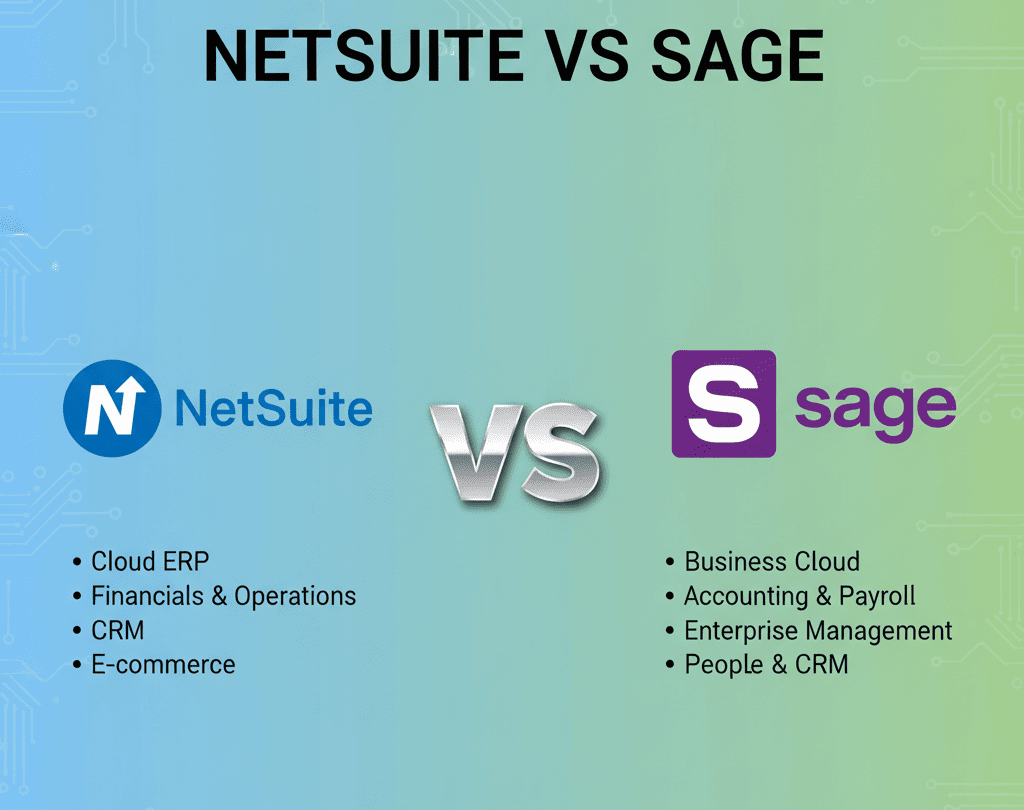
What is the core functional difference between NetSuite and Sage Intacct?
NetSuite provides a full operational ERP platform while Sage Intacct provides best-in-class financial management and reporting.
Oracle NetSuite combines ERP, CRM, inventory, order management, SuiteCommerce e-commerce, SuiteAnalytics reporting and PSA into a single data model so operations and finance share one record of truth. Sage Intacct focuses on accounts payable, accounts receivable, cash management, a dimensional general ledger and native multi-entity consolidation, and it expects operational systems to connect via API or middleware. That means NetSuite reduces the number of integrations you maintain, while Sage Intacct usually integrates with third-party systems such as Salesforce for CRM, Shopify for commerce, or a dedicated WMS for inventory. The trade-offs matter: choose NetSuite if you need end-to-end process coverage, choose Sage Intacct if your main goal is fast, auditable financial close and reporting.
What is Oracle NetSuite and who uses it?
Oracle NetSuite is a unified cloud business platform that runs ERP, CRM, inventory, e-commerce and PSA natively.
NetSuite OneWorld and the NetSuite suite cover general ledger, accounts payable, accounts receivable, fixed assets, order management, warehouse management, SuiteCommerce for e-commerce, and SuiteAnalytics for reporting. Midmarket companies, distributors, multinationals with intercompany and multi-subsidiary needs, and businesses that want to consolidate sales, service and finance on one platform commonly adopt NetSuite. NetSuite also includes SuiteCloud developer tools and SuiteScript for customizations. If you want a single vendor to manage your core business workflows from order to cash and procurement to pay, NetSuite is purpose-built for that scenario.
What is Sage Intacct and who uses it?
Sage Intacct is a cloud-native financial management and accounting system built for finance teams and multi-entity consolidation.
Sage Intacct provides a dimensional general ledger, core GL, AP, AR, cash management, purchasing, fixed assets and project accounting, and it exposes a robust REST API for integrations. Finance-led organizations, professional services, software-as-a-service (SaaS) businesses, and nonprofit finance teams favor Sage Intacct because of its reporting flexibility, audit trail and streamlined period close capabilities. Sage Intacct’s dashboards and metrics are designed to give the CFO and controllers quick answers without heavy technical intervention. For organizations that already have specialized operational systems, Sage Intacct acts as a finance system of record with well-known connectors to Salesforce and payroll vendors.
How do NetSuite and Sage Intacct compare on multi-entity and consolidation?
Sage Intacct typically gives faster, more automated multi-entity consolidation than NetSuite’s native process.
Sage Intacct’s multi-entity architecture and intercompany eliminations are built into the dimensional ledger to produce consolidated financial statements quickly, which reduces manual journal adjustments during close. NetSuite supports multi-subsidiary operations via NetSuite OneWorld, but complex consolidations often require additional configuration or supplemental intercompany processes. That means for a finance-led rollup of many legal entities, Sage Intacct typically shortens close cycles. If you need consolidated financials plus inventory and intercompany order flows inside the same system, NetSuite may still be preferable despite a longer setup for consolidations.
How much do these systems cost in 2026?
Neither Oracle NetSuite nor Sage Intacct posts a simple list price; both provide quote-based pricing that depends on modules, users and implementation scope.
Because pricing is bespoke, the practical way to estimate cost is to define required modules, user counts and integration needs, then request proposals. Budget items to include are subscription fees, implementation services, middleware or integration platform costs, ongoing support, and third-party apps such as a warehouse management system or Salesforce CRM if you use Sage Intacct. For project planning, ask vendors for a full three-year total cost of ownership including subscription, implementation, training and annual maintenance. For a deeper NetSuite pricing breakdown and feature-level pricing guide, see the NetSuite review.
Which one fits you? (Who should choose which?)
Choose based on whether your priority is operational scope or finance-first depth.
Profiles and recommendations:
- Finance-first midmarket (recommended Sage Intacct): If you are a CFO focused on fast close, complex reporting and multiple legal entities, Sage Intacct is better because of its dimensional GL and built-in consolidations.
- Operationally complex business (recommended NetSuite): If you need unified inventory, order-to-cash, CRM and ecommerce in one system, NetSuite is better because it removes integration points and keeps one data model.
- Professional services firm (recommended Sage Intacct + PSA): Firms that bill by project and need project accounting, time and expense integration often prefer Sage Intacct combined with a PSA system or Salesforce integration.
- Growing distributor or manufacturer (recommended NetSuite): Companies that need WMS, manufacturing or advanced order management benefit from NetSuite’s inventory and manufacturing modules.
Which roles and hires matter when implementing each system?
NetSuite projects need ERP systems builders; Sage Intacct projects need senior finance system owners and integration architects.
For NetSuite, you typically hire or contract a certified NetSuite solution architect, NetSuite developers familiar with SuiteScript and SuiteCloud, and functional consultants for finance, inventory and commerce. For Sage Intacct, the essential hires are a senior finance systems analyst, a Sage Intacct consultant, and an integration specialist (often for Salesforce or a payroll vendor). Staffing costs differ: expect higher development effort on NetSuite when you customize workflows, and more finance-process design work on Sage Intacct to map dimensions and consolidations. That staffing trade-off is the single-hire decision many buyers miss; your choice often comes down to hiring a systems builder versus a finance process owner.”
How do integrations and ecosystem differ between the two?
NetSuite aims to be the single platform so it has many native modules; Sage Intacct expects integrations and provides a broad connector ecosystem.
NetSuite’s SuiteCloud ecosystem includes SuiteApps for native extensions, SuiteCommerce for web storefronts, and native CRM capabilities. Sage Intacct emphasizes open APIs and certified connectors for Salesforce CRM, ADP payroll, Avalara tax, and other midtier systems. If you already run Salesforce for sales and service, Sage Intacct often plugs in with less disruption. If you prefer fewer third-party moving parts and native order, inventory and CRM, NetSuite reduces integration maintenance. Consider whether you prefer a single-vendor stack or best-of-breed integrated components when planning architecture and budget.
How do they compare on inventory, manufacturing and e-commerce?
NetSuite includes inventory, order management, manufacturing and e-commerce natively; Sage Intacct does not include full warehouse or manufacturing modules.
NetSuite supports advanced inventory features: lot and serial tracking, demand planning, work orders, shop floor control, and SuiteCommerce for online storefronts. Sage Intacct’s core strength is finance; companies that use Sage Intacct for accounting commonly pair it with dedicated WMS, ERP-lite or manufacturing systems that integrate financials into the Sage ledger. If your business depends on inventory accuracy, detailed BOM and production planning within the same system, NetSuite reduces reconciliation work and integration risk.
What hidden costs and trade-offs do buyers often miss?
The largest hidden costs are integrations, customizations, change management and ongoing reporting build, not just subscription fees.
Buyers often focus on subscription price but underestimate integration platform fees, middleware subscriptions, third-party connectors, custom SuiteScript or integration mapping labor, and internal change management costs like training and process redesign. For example, when replacing a combined ecommerce plus warehouse plus ERP environment with Sage Intacct plus third-party WMS and Shopify, you must budget for connector licensing and recurring support. Oracle NetSuite may reduce integration costs but increases initial implementation scope. Also consider long-term reporting needs: building consolidated reports in NetSuite sometimes requires SuiteAnalytics work while Sage Intacct’s dimensional reporting reduces BI spend. Another frequently missed trade-off is vendor dependency: NetSuite centralizes support with Oracle, Sage Intacct spreads responsibility across multiple vendors when using best-of-breed pieces. Ownership facts matter: Oracle acquired NetSuite in 2016 for about $9.3 billion, and Sage Group acquired Intacct in 2017 for about $850 million, which explains why each product aligns to different product roadmaps and partner ecosystems (Oracle press release, 2016; Sage press release, 2017).
What are common mistakes buyers make, and how do you avoid them?
Common mistakes include buying on feature checklists, under-scoping integrations and not involving finance early enough.
Top mistakes and fixes: 1) Selecting based solely on one feature set causes surprises when other functions fail; instead run a 90-day pilot for your core process. 2) Ignoring integration costs; include estimated middleware and connector fees in the RFP. 3) Leaving finance out of vendor selection; include the CFO and controller for requirements and sign-off. 4) Underestimating change management; plan training with role-based learning. 5) Choosing the system that looks simpler initially without projecting three-year growth in users, entities or channels. Address these by defining KPIs, mapping order-to-cash and purchase-to-pay flows, and building a realistic TCO spreadsheet.”
What practical checklist should you use before choosing?
Use a requirements checklist that forces you to quantify needs for finance, operations, integrations, users and timelines.
- Define required modules: GL, AP, AR, inventory, order management, CRM, PSA, e-commerce.
- List number of legal entities, currencies and intercompany flows.
- Map integrations: Salesforce, Shopify, payroll, WMS and tax engines.
- Estimate users by role: finance, sales, warehouse, customer service, management.
- Set target go-live date, and allow buffer for customizations and data migration.
- Request three-year TCO for subscription, implementation, connectors and support.
- Ask for references from companies in your industry and similar scale.
Worked examples: how to estimate real cost and scope
Worked examples help translate vendor quotes into annual budgets by counting subscription, implementation, connectors and support.
Example 1, small nonprofit finance-first: assume Sage Intacct subscription for GL, AP, AR and consolidation, plus two finance users and one admin. Your main costs are subscription, a 3-month implementation and Salesforce connector. Example 2, 50-person ecommerce distributor: assume NetSuite with SuiteCommerce, inventory and WMS integration, plus five operational users and three finance users; dominant costs are initial implementation, SuiteCommerce setup and warehouse integration. Example 3, professional services firm with 6 entities: Sage Intacct with project accounting and multi-entity consolidations will shorten close time and lower consultant hours during month-end. For precise budgeting, ask vendors for itemized quotes and use a three-year cashflow model to compare TCO between NetSuite’s higher implementation scope and Sage Intacct’s integration-driven model.
Comparison at a glance
| Product | Price range | Best for | Key strengths | Main limits |
|---|---|---|---|---|
| Oracle NetSuite | Quote-based subscription, modules and implementation fees | Companies needing unified ERP, CRM, inventory and e-commerce | Single data model, native inventory, SuiteCommerce, SuiteCloud | Longer implementation for complex customizations, higher initial scope |
| Sage Intacct | Quote-based subscription, module pricing and connector fees | Finance-led organizations needing deep reporting and consolidation | Dimensional GL, fast consolidations, finance-friendly reporting | No native WMS or full e-commerce; relies on third-party integrations |
Who should NOT use NetSuite or Sage Intacct?
Neither product is ideal for microbusinesses with simple accounting, or companies unwilling to invest in implementation and change management.
If you run a 1 to 5 person business with simple invoicing, QuickBooks or Xero are more appropriate. If you need heavy manufacturing shop-floor controls for high-volume production, consider SAP S/4HANA or a specialized MES with ERP integration. If you do not have budget for implementation, ongoing support and integrations, postpone a midtier ERP project until you can plan proper staffing and rollout. For more small-business alternatives, review pricing and options for lower-tier accounting systems.
Final summary: which ERP is best in 2026?
NetSuite is better for companies that need an all-in-one cloud ERP to handle finance, inventory, CRM, e-commerce and PSA with one data model; Sage Intacct is better for companies that want superior finance capabilities, faster consolidation and flexible dimensional reporting.
Your decision rule: if you want one vendor and minimal integrations, choose Oracle NetSuite because it centralizes operations; if finance controls and consolidated reporting are the purchase drivers, choose Sage Intacct because it reduces month-end effort and supports finance-led processes. For vendor selection workflows and vendor comparison templates, consult the business software guide to structure your RFP and TCO analysis.
FAQs
- Is Sage better than NetSuite?
Direct answer: Not universally, they serve different needs. Sage Intacct is better for finance teams wanting deep reporting, while NetSuite is better for unified operational ERP. Pick based on whether finance or operations is the primary driver.
- What are the top 3 ERP systems?
Direct answer: It depends on company size and needs. Common leaders include Oracle NetSuite for midmarket unified ERP, SAP S/4HANA for large global enterprises, and Microsoft Dynamics 365 for organizations invested in Microsoft ecosystems.
- How much will NetSuite cost in 2026?
Direct answer: NetSuite is quote-based and variable; contact Oracle NetSuite for a tailored price. When planning, request a three-year TCO that includes subscriptions, implementation, connectors and support to compare against Sage Intacct.
- Who is NetSuite’s biggest competitor?
Direct answer: Competitors depend on the buyer. Sage Intacct competes on finance-first features. Microsoft Dynamics 365, SAP Business ByDesign and Acumatica compete in the broader ERP space for similar midmarket buyers.
- Which ERP is better for small businesses?
Direct answer: For very small businesses, QuickBooks or Xero are usually better. For growing small businesses that need strong finance controls, Sage Intacct is a good step. For small businesses that will centralize operations, NetSuite can be appropriate once you outgrow accounting-only systems.
- Can Sage Intacct replace NetSuite for inventory?
Direct answer: No, Sage Intacct lacks a full native inventory and warehouse management suite. Replacing NetSuite’s inventory capabilities requires third-party WMS or ERP modules and integration work with Sage Intacct.