BuzzSumo Review: BuzzSumo is one of the most powerful content research and social listening tools available for marketers, PR professionals, agencies, and enterprises. Content creation today is highly competitive, and identifying trending topics, viral content, and influential voices is crucial for success. BuzzSumo provides data-driven insights that help marketers discover high-performing content, track brand mentions, analyze competitors, and improve outreach strategies.
Unlike traditional SEO tools, BuzzSumo focuses on content performance, social engagement metrics, and influencer discovery, making it an essential platform for content marketers who want to make smarter, data-backed decisions quickly.
Quick Verdict: BuzzSumo is one of the most powerful content intelligence platforms available today — but it comes with a premium price tag. For mid-to-large content teams, agencies, and PR professionals, it delivers exceptional value. For solopreneurs or pure SEO-focused users, cheaper alternatives may serve you better.
| Criteria | Rating | Details |
| Overall Performance | ⭐⭐⭐⭐☆ (4/5) | Strong for content & trend research |
| Ease of Use | ⭐⭐⭐⭐☆ | Beginner-friendly dashboard, easy navigation |
| Content Discovery | ⭐⭐⭐⭐⭐ | Finds trending & viral content across platforms |
| Competitor Analysis | ⭐⭐⭐⭐☆ | Analyze top competitors’ best-performing content |
| Influencer Research | ⭐⭐⭐⭐☆ | Identify niche-relevant influencers quickly |
| Pricing Value | ⭐⭐⭐☆ | Expensive for small teams |
| Data Accuracy | ⭐⭐⭐⭐☆ | Reliable social engagement & share data |
What Is BuzzSumo?
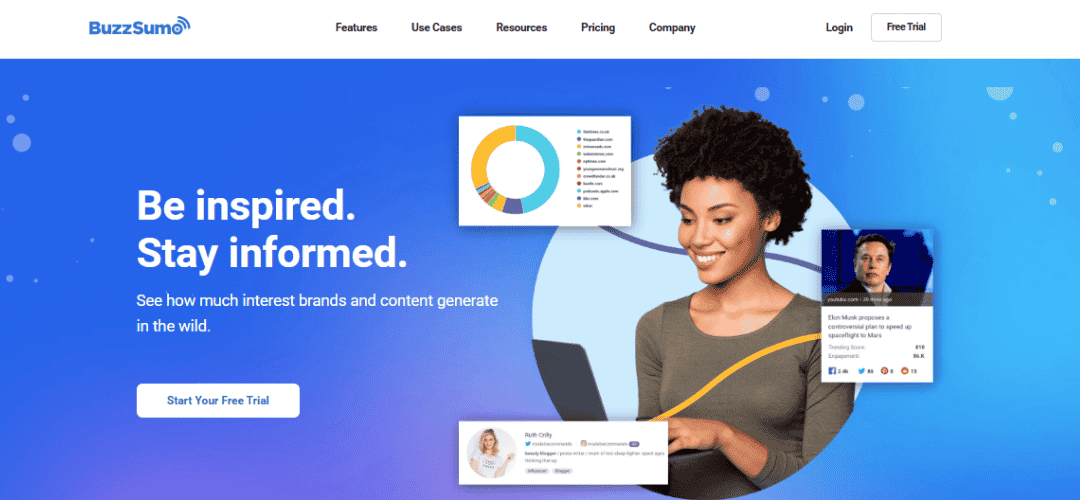
BuzzSumo is a cloud-based content research and social media analytics platform that helps marketers, PR professionals, and content creators discover trending content, analyze competitor performance, track brand mentions, and identify influencers in any niche.
Founded in 2014 and later acquired by Brandwatch in 2017, BuzzSumo has grown into a go-to tool for data-driven content strategy. It indexes billions of pieces of content and tracks social engagement metrics across platforms including Facebook, Twitter/X, Pinterest, Reddit, and more.
Whether you’re trying to figure out what content resonates with your target audience, spy on what your competitors are publishing, or find the right influencers to amplify your brand — BuzzSumo has tools designed to do exactly that.
This review is written for:
- Content marketers and strategists
- SEO professionals and link builders
- PR and communications teams
- Digital marketing agencies
- Bloggers and freelance writers scaling their output
BuzzSumo as a Content Research + Social Listening Tool
BuzzSumo combines content discovery with real-time monitoring. Users can research articles, videos, and posts while also tracking brand mentions, competitor activity, and industry conversations.
BuzzSumo vs Traditional SEO Tools
| Feature Area | BuzzSumo | Traditional SEO Tools |
| Focus | Content performance & engagement | Rankings & backlinks |
| Data Source | Social signals & online publications | Search engine data |
| Best For | Content ideation, PR, trend discovery | Technical SEO & site audits |
| Keyword Difficulty | ❌ No | ✅ Yes |
What Does BuzzSumo Do? (Feature Overview)
Before we dive into the details, here’s a high-level look at what BuzzSumo is built to do:
Content Discovery & Research — Find the highest-performing content on any topic or domain. Understand what’s resonating right now so you can create better, more targeted content.
Competitor Analysis — Benchmark your content performance against competitors and discover the gaps and opportunities they’re missing.
Influencer Research — Locate key voices, journalists, and creators in your niche who can amplify your content or brand.
Brand Monitoring & Alerts — Track mentions of your brand, competitors, or keywords in real-time across the web and social media.
Audience Question Research — Uncover the exact questions your audience is asking so you can create content that ranks for informational queries.
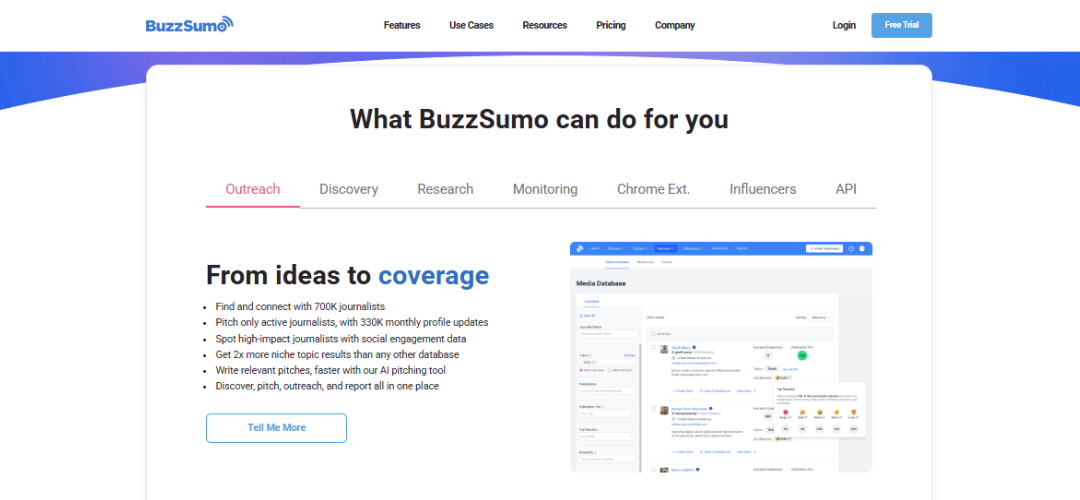
BuzzSumo Key Features — Deep Dive
1. Content Analyzer
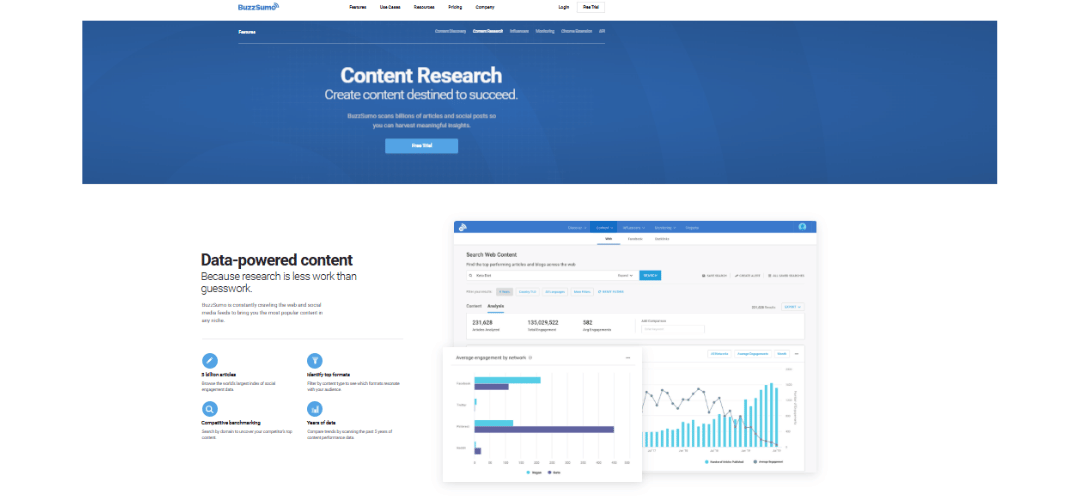
The Content Analyzer is BuzzSumo’s flagship feature and arguably the most useful tool in the entire platform.
Enter any keyword or topic, and BuzzSumo will surface the most-shared content related to that subject, pulled from billions of indexed articles. You can filter results by date range, content type (article, video, infographic), language, country, and engagement metrics like total shares, Facebook engagements, or backlinks.
This is incredibly powerful for ideation. Instead of guessing what might perform well, you’re working from real data. Want to write about “sustainable fashion”? You can instantly see which angles, headlines, and formats have generated the most engagement in the last 6 months.
What makes it stand out: The ability to filter by “evergreen score” helps you identify content that has long-term shareability rather than just trending spikes. This is pure gold for content strategists who are planning editorial calendars.
2. Domain Analysis
Type in any website URL and BuzzSumo gives you a full breakdown of that domain’s top-performing content. You can see:
- Their most shared articles of all time or within a time period
- Which content types get the most engagement
- Average social shares per post
- Their most popular authors
This is invaluable for competitive research. If you’re competing with a specific blog or brand, you can reverse-engineer their content strategy and find patterns in what’s working for them — then do it better.
3. Influencer Search
BuzzSumo’s influencer search lets you find key voices in any topic area. You can search by keyword and filter by influencer type (bloggers, journalists, regular people, companies), follower count, domain authority, engagement ratio, and more.
Each influencer profile shows their most shared content, what topics they typically cover, and how engaged their audience is. This is particularly useful for outreach campaigns, PR pitches, and link-building efforts.
Caveat: The influencer database has improved significantly in recent years, but some users report that the data can occasionally feel outdated, especially for micro-influencers in niche verticals.
4. Question Analyzer
One of BuzzSumo’s more underrated features, the Question Analyzer scrapes forums, Q&A sites (like Quora and Reddit), and other platforms to surface the most commonly asked questions about any topic.
This is a dream tool for SEO content writers targeting featured snippets and FAQ sections. You get real audience language — the actual words people use when searching for information — which can dramatically improve the relevance and search performance of your content.
5. Brand Monitoring & Alerts
Set up alerts for your brand name, a competitor, a specific keyword, or even an author name. BuzzSumo will notify you when new content is published that matches your criteria.
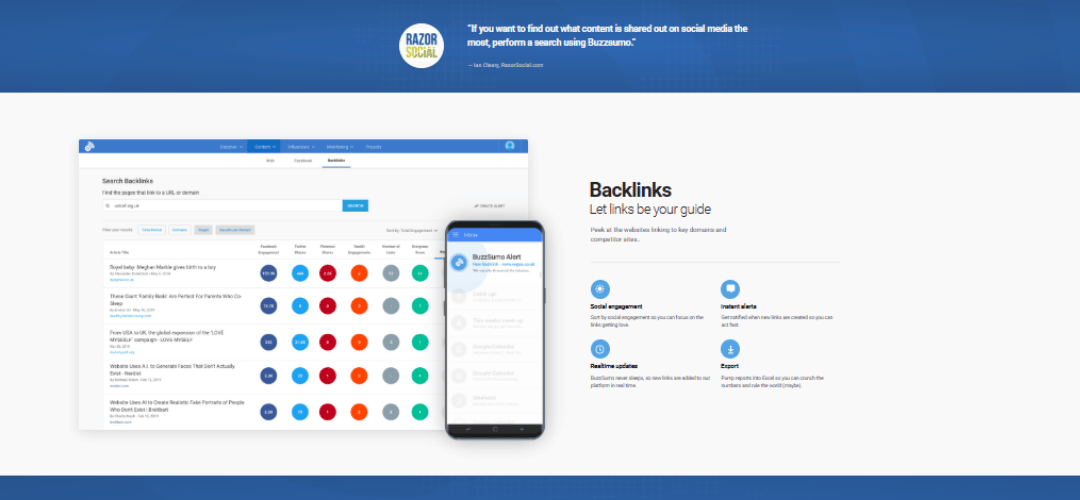
You can also monitor who’s linking to your content or competitors’ content, making it a lightweight tool for backlink monitoring and outreach opportunity identification.
Alerts can be delivered daily, weekly, or in real-time, which keeps your team informed without being overwhelming.
6. Trending Feeds
BuzzSumo’s trending content feeds show you what’s getting the most traction right now — broken down by topic, country, and time frame. This is useful for newsjacking, staying on top of your industry’s conversation, and quickly identifying viral opportunities before they peak.
7. YouTube & Reddit Research
In more recent product updates, BuzzSumo expanded its capabilities to include YouTube analytics (which videos perform well for specific topics) and Reddit research (which subreddits and posts are driving the most engagement). These additions make BuzzSumo a more complete content intelligence suite, especially for brands with video or community-driven strategies.
8. API Access
BuzzSumo offers API access on higher-tier plans, allowing developers and data teams to pull content performance data directly into their own tools, dashboards, or reporting systems. This is particularly valuable for agencies managing multiple clients or large enterprises with custom reporting needs.
BuzzSumo Pricing Plans (2026)
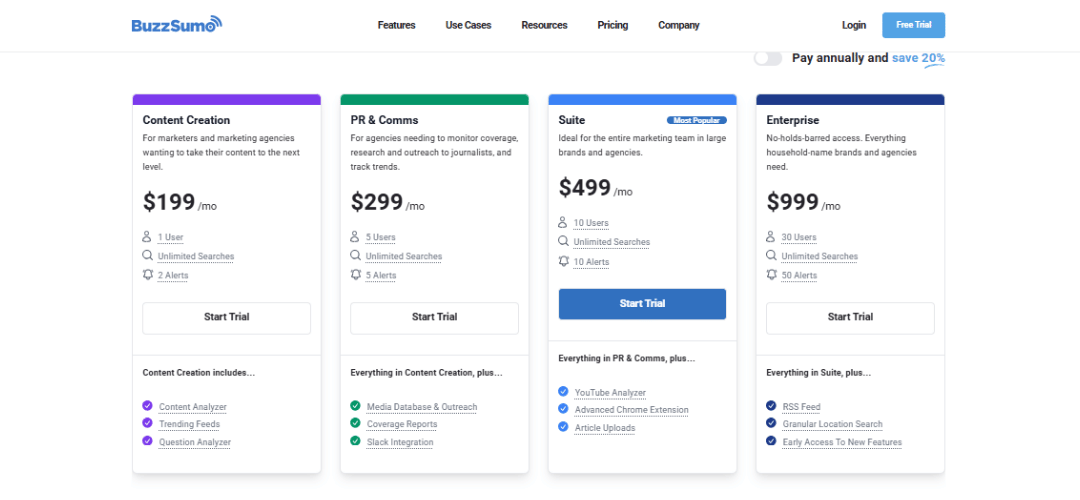
BuzzSumo offers several pricing tiers designed for different use cases. Note that pricing can change — always verify on their official website.
| Plan | Best For | Key Limits |
|---|---|---|
| Content Creation | Bloggers, solo marketers | Basic content search, limited alerts |
| PR & Comms | PR teams and communications pros | Journalist database, media monitoring |
| Suite | Marketing teams and agencies | Full feature access, more searches |
| Enterprise | Large orgs, custom needs | API access, custom onboarding, higher limits |
Free Trial: BuzzSumo typically offers a 30-day free trial, which is generous enough to properly test the platform before committing.
Is the price justified? For solo users or small businesses on tight budgets, the pricing will feel steep. But for an agency running content campaigns for multiple clients, or an in-house marketing team that produces content at scale, the ROI can be significant. The platform essentially replaces several separate tools — content research, brand monitoring, influencer research, and competitor analysis — which helps justify the cost.
BuzzSumo Pros and Cons
Pros
Unmatched content research depth. No other tool comes close to BuzzSumo’s database of content performance data. If you need to know what’s working in any topic area, BuzzSumo has the answer.
Excellent for link building. The ability to find top-performing content by topic and see who shared it makes BuzzSumo a powerful tool for identifying link-building opportunities and outreach targets.
Strong influencer and journalist database. The influencer search goes beyond just social media stats — you can find journalists and writers who’ve covered specific topics, which is gold for PR outreach.
Intuitive interface. Despite the depth of data it offers, BuzzSumo’s UI is clean and easy to navigate. Most features are accessible within a few clicks.
Versatile across teams. Unlike tools designed exclusively for SEO or exclusively for PR, BuzzSumo genuinely serves multiple functions across content, PR, and marketing teams.
Cons
Pricing is a barrier for small businesses. The platform is expensive, especially at the higher tiers. Freelancers and small teams often find it hard to justify the monthly cost.
Limited SEO keyword data. If your primary need is keyword research and search volume data, dedicated SEO tools like Ahrefs or Semrush will serve you much better. BuzzSumo is focused on content performance and social engagement, not keyword ranking.
Search limits on lower plans. The entry-level plans cap the number of searches you can run per month, which can be frustrating if you’re doing heavy research.
Data recency gaps. Some users have reported that very recent content (published within hours) doesn’t always appear immediately in search results, which can be a minor frustration when tracking real-time trends.
Influencer data occasionally outdated. While the database is large, some influencer profiles contain stale information — particularly for smaller, niche creators.
| Pros | Cons |
| Best-in-class content research capabilities | Expensive for small teams |
| Strong historical content analysis | Limited execution tools compared to full marketing suites |
| Excellent for PR and outreach | Some features locked behind higher plans |
| Share-driven insights for social engagement | N/A |
What Real Users Are Saying: BuzzSumo Reviews Roundup
Pulling from verified reviews across G2, Capterra, and Trustpilot, here’s what real users say about BuzzSumo:
Common Praise Themes
Users consistently highlight the content discovery features as best-in-class. Marketers love how quickly they can validate content ideas with real engagement data rather than guesswork. The alerts feature receives high marks for keeping teams informed about brand mentions and competitor activity without requiring manual monitoring.
PR professionals frequently praise the journalist search capabilities, noting that it significantly reduces the time spent on media research and outreach list building.
Many agency users point to the domain analysis tool as one of the most valuable features — being able to quickly analyze a client’s competitive landscape before a strategy call is a significant time saver.
Common Criticisms
Price is the number one complaint across platforms. Many reviewers note that BuzzSumo is “worth it if you can afford it” — but the jump between plans can feel steep.
Some users feel that social share data has become less reliable as platforms like Twitter/X have made engagement data harder to access. This has impacted the accuracy of some engagement metrics in recent years.
Customer support response times have received mixed reviews, with some users reporting delays during peak periods.
Aggregate Ratings (Approximate)
- G2: ~4.5 / 5
- Capterra: ~4.5 / 5
- Trustpilot: ~4.0 / 5
BuzzSumo in Action: Real-World Use Cases
Use Case 1: Content Marketer Building an Editorial Calendar
A content marketer at a SaaS company uses BuzzSumo’s Content Analyzer to research what topics in their industry have driven the most engagement over the past 6 months. They filter for long-form articles with high share counts and use those patterns to shape their quarterly content calendar — focusing on topics and angles that have proven audience demand rather than assumptions.
They also set up competitor domain alerts so they’re automatically notified when rivals publish new content, allowing the team to respond quickly with complementary or counter-perspective pieces.
Use Case 2: PR Professional Running an Outreach Campaign
A PR professional launching a new product uses BuzzSumo to find journalists and bloggers who have previously written about similar products in the space. Instead of mass-blasting a generic press release, they create a targeted media list of writers with real audience engagement in the relevant niche — dramatically improving open rates and media placement success.
Use Case 3: Agency Managing Multiple Clients
A digital marketing agency uses BuzzSumo’s domain analysis to run competitive audits for new client onboarding. In under an hour, they can identify each client’s top competitors, understand the content strategies driving their traffic, and pinpoint gaps where the client can differentiate. This transforms a task that used to take days of manual research into a streamlined, data-backed process.
BuzzSumo Alternatives & Competitors
BuzzSumo is strong, but it’s not the only option. Here’s how it stacks up against alternatives:
| Tool | Best For | Compared to BuzzSumo |
|---|---|---|
| Ahrefs Content Explorer | SEO + content research | Better SEO data; less social engagement focus |
| Semrush Topic Research | Keyword + content ideation | Broader SEO suite; content research is secondary |
| SparkToro | Audience research | Better for understanding where your audience hangs out |
| Exploding Topics | Emerging trend discovery | Simpler, cheaper; great for spotting trends early |
| Mention / Brand24 | Brand monitoring | Cheaper brand monitoring solutions; less content research depth |
Bottom line on alternatives: If your primary need is content research and social performance data, BuzzSumo is best-in-class. If SEO data is your priority, Ahrefs or Semrush will serve you better. If budget is a major concern, Exploding Topics or Brand24 offer narrower but more affordable solutions.
Who Should (and Shouldn’t) Use BuzzSumo?
BuzzSumo is a great fit for:
- Content marketing teams producing 4+ pieces of content per week who need reliable data to guide topic selection and strategy
- PR agencies and communications professionals who do regular media outreach and journalist research
- Digital marketing agencies managing multiple client content strategies simultaneously
- Link builders looking for proven content to reverse-engineer for outreach campaigns
- Large brands that need to monitor their online reputation and track brand mentions at scale
BuzzSumo is probably NOT the right fit for:
- Solo freelancers or micro-businesses where the price outweighs the value
- Pure SEO professionals who need keyword ranking and backlink analysis above all else — Ahrefs or Semrush are better suited
- Businesses just starting out with content marketing who haven’t yet built a volume of content that justifies this level of analysis
- Social media managers primarily focused on scheduling and posting — dedicated social media management tools are better for that workflow
Who Is BuzzSumo Best For?
Content Marketers & Bloggers
Ideal for discovering proven content formats, headlines, and angles.
SEO Professionals
Excellent for top-of-funnel ideation and link-worthy asset planning.
Digital PR & Link-Building Teams
Strong media database, journalist discovery, and outreach intelligence.
Agencies Managing Multiple Brands
Supports competitive benchmarking and cross-industry research.
Enterprises Monitoring Brand Mentions
Advanced alerts and reputation tracking at scale
Final Verdict
BuzzSumo remains one of the most comprehensive and reliable content intelligence platforms on the market in 2026. Its content research depth, influencer discovery capabilities, and brand monitoring tools make it genuinely indispensable for teams that take content marketing seriously.
The platform’s biggest limitation is price — it’s an investment that only makes sense when you have the team size and content volume to fully utilize what it offers. For agencies and mid-to-large marketing teams, the ROI is clear. For individual creators or small businesses, the calculus is harder to justify.
If you’re on the fence, take advantage of the free trial and pressure-test the content analyzer and domain analysis features with real projects. Within a week, you’ll know pretty clearly whether BuzzSumo is going to become a core tool in your stack or a luxury you can live without.
Frequently Asked Questions
Is BuzzSumo free? BuzzSumo offers a 30-day free trial with access to its core features. After the trial period, you’ll need a paid plan to continue using the platform. There is no permanently free tier.
Is BuzzSumo worth it? For content marketing teams, PR professionals, and agencies producing content at scale, yes — BuzzSumo is worth the investment. For solo bloggers or businesses just starting out, the pricing may feel steep relative to the value they can extract.
What is BuzzSumo best used for? BuzzSumo is best used for content research and ideation, competitive content analysis, influencer and journalist outreach, and brand monitoring. It excels when you need data-backed insights into what content resonates with a specific audience.
How accurate is BuzzSumo’s data? BuzzSumo’s data is generally considered reliable, particularly for content published on major platforms. That said, changes to social media APIs (especially Twitter/X) have made some engagement metrics less precise in recent years. The platform is most accurate for identifying content trends and top performers rather than exact share counts.
What is the best BuzzSumo alternative? It depends on your use case. For SEO-heavy content strategies, Ahrefs Content Explorer is the top alternative. For budget-conscious users, Exploding Topics or Brand24 offer solid value. For audience research, SparkToro is an excellent complement or replacement.