Summary of Key Categories
These 250 statistics capture the scale and impact of conversational AI heading into 2026. The data span market growth, adoption patterns, customer‑service efficiency, business ROI, industry‑specific adoption, platform dynamics, consumer preferences and future trends. Collectively, they show chatbots evolving from experimental tools to core infrastructure across industries, with a strong growth trajectory and nuanced consumer expectations.[1] Below is a numbered list of evidence‑based statistics organized into thematic sections. Each fact includes a citation to its source.
Market Size & Growth
- In 2024 the global chatbot market was valued at $7.76 billion and is projected to hit $27.29 billion by 2030, implying a 23.3 % CAGR[2].
- Mordor Intelligence projects the market at $11.45 billion in 2026 and $32.45 billion by 2031, growing 23.15 % annually[3].
- Roots Analysis estimates the chatbot market could reach $61.97 billion by 2035[4].
- One bullish forecast places the market at $9.3 billion in 2025 and $27.07 billion by 2030[5].
- MarketsandMarkets sees the chatbot market rising from $5.4 billion in 2023 to $15.5 billion by 2028[6].
- Fortune Business Insights estimates the generative AI chatbot segment will surge from $7.66 billion in 2024 to $65.94 billion by 2032, a 31.1 % CAGR[7].
- North America represented 38.72 % of the global chatbot market in 2025 (≈$3.6 billion)[8].
- The Asia–Pacific region is the fastest‑growing chatbot market with a 24.71 % CAGR through 2031[9].
- The Middle East and Africa may surpass even Asia–Pacific, with ≈26 % CAGR projected through 2030[10].
- Customer service drives around 62 % of chatbot market revenue[11].
- Sales and marketing accounts for 41 % of chatbot deployments[12].
- IT departments lead internal use: 53 % of organizations deploy chatbots for technical support[13].
- Real estate has ~28 % adoption, the highest among industries using chatbots for lead qualification[14].
- Travel and hospitality follows with 11 % adoption[15].
- Education uses chatbots in 14 % of use cases[16].
- Healthcare currently adopts chatbots in 10 % of cases but has one of the fastest growth trajectories[17].
- Hyperleap AI notes the AI chatbot market grew from $1.2 billion in 2024 to $2.8 billion in 2025—a 133 % year‑on‑year increase[18].
- Hyperleap projects the market will reach $10.8 billion by 2030 and adoption by 85 % of businesses[19].
- Hyperleap reports an average 28.5 % CAGR for AI chatbots between 2024–2029[18].
- Despite macroeconomic headwinds, businesses continued investing in conversational AI through 2024–25, underscoring the technology’s resilience[20].
Adoption & Usage Patterns
- Datareportal estimates about 1.5 billion people worldwide use chatbots[21].
- Ipsos research shows 68 % of consumers have used customer‑service chatbots[22].
- Statista’s late‑2024 survey of 8,301 consumers found chatbots are used for scheduling appointments (≈50 %), placing orders (47 %), reporting issues or returns (46 %) and tech support (45 %)[23].
- Tidio reports 82 % of respondents would use a chatbot rather than wait for a human[24].
- 27 % of shoppers use chatbots daily and 34 % a few times per week[24].
- About 96 % of consumers think companies using chatbots care about their customers[25].
- Tidio data show 64 % of customers trust chatbots and 60 % say bots influence their purchase decisions[26].
- Roughly 90 % of chatbot inquiries are resolved within 11 messages[24].
- WytLabs notes ≈987 million people use AI chatbots regularly[27].
- 88 % of people have had at least one chatbot conversation in the past year[28].
- Master of Code found 80 % of users have interacted with chatbots previously[29].
- 73 % of customers expect websites to offer chatbots for convenience[29].
- 74 % of internet users prefer chatbots for simple questions[29].
- 69 % appreciate chatbots’ quick responses and 59 % expect replies within 5 seconds[30].
- 48 % prioritise issue resolution over speed when interacting with bots[30].
- 65 % of users feel comfortable completing tasks via chatbot without human assistance[30].
- Hyperleap AI reports 67 % of customers prefer messaging apps (WhatsApp/Facebook Messenger) over phone or email for support[19].
- 82 % of customers expect an instant response from chatbots[19].
- Customer satisfaction with chatbots averages 92 %[19].
- 68 % of customers prefer AI over humans when tasks are routine[19].
- 74 % of businesses require multilingual chatbot support[19].
- 45 % of enterprise chatbot deployments include voice; this is expected to rise to 78 % by 2026[19].
- Mobile dominates: 89 % of chatbot interactions occur on phones[19].
- The average chatbot session lasts 4.2 minutes[19].
- Hyperleap AI estimates chatbots boost revenue by 15–35 % and cut operating costs by 30–40 %[19].
- Chatbots raise lifetime customer value by 25 % on average[19].
- Cart‑abandonment rates drop ≈23 % when chatbots are used[19].
- Average ROI for AI chatbots is 340 % in the first year[19].
- Chatbots achieve 94 % response accuracy, respond within 11 seconds and resolve 87 % of queries; only 13 % require escalation[19].
- 15 % of chatbot platforms claim zero hallucination rates[19].
- Multi‑language chatbots deliver 91 % accuracy and retain context in 85 % of interactions[19].
- Industry adoption rates: 78 % e‑commerce, 65 % hospitality, 52 % healthcare, 71 % financial services, 58 % real estate, 43 % education[19].
- 89 % of Gen Z prefer AI chatbots, compared with 76 % of millennials and 82 % of business travellers[19].
- Mobile commerce transactions via chatbots increased 156 % year over year[19].
- Chatbot usage peaks between 8 p.m. and 11 p.m. local time[19].
- About 67 % of users return for repeat chatbot interactions[19].
- 85 % of businesses will deploy chatbots by 2030, according to Hyperleap’s forecasts[19].
- WytLabs data show 64 % of businesses rely on chatbots for personalisation and 41 % use AI to reduce headcount[31].
- 95 % of customer interactions are projected to be powered by AI by 2025[32].
- 55 % of tech companies using chatbots for marketing saw an increase in high‑quality leads[33].
- 80 % of people rate their chatbot interactions as positive[34].
- 41 % of businesses using chatbots for sales report an average 67 % rise in sales[35].
- North America accounts for 30.7 % of chatbot revenue and Asia–Pacific is growing at ≈24 % CAGR[36].
- 8.4 million businesses use voice assistance technology and adoption grows about 2.9 % per year[37].
- Text‑based chatbots are used by 60 % of B2B companies and 42 % of B2C companies[38].
- 40 % of small enterprises (<250 employees) use chatbots[39].
- 40 % of small and medium businesses have adopted chatbots[40].
- 70 % of medium to large enterprises use virtual assistants to enhance efficiency[41].
- 12 % of U.S. adults aged 18‑29 use generative AI chatbots for work weekly, compared with 6 % of adults aged 50‑64[42].
- G2 observes chatbots can autonomously handle up to 80 % of support questions[43].
Customer Service Chatbot Statistics
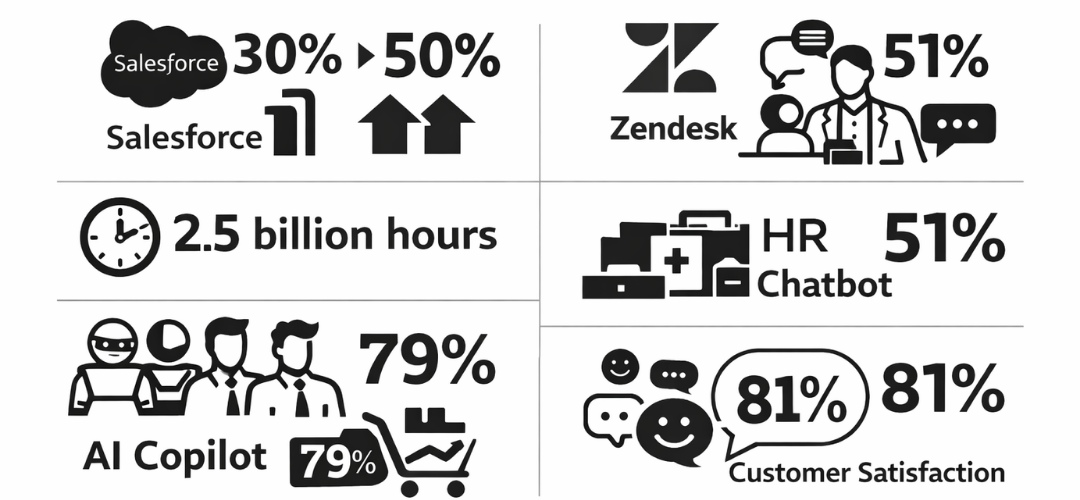
- Salesforce reports AI chatbots resolved 30 % of service cases in 2025 and are expected to handle 50 % by 2027[44].
- Gartner data reveal chatbots resolve 58 % of returns and cancellations but only 17 % of billing disputes[45].
- Zendesk research found 51 % of consumers prefer bots when they want immediate service[46].
- 84 % of consumers still want a human option when dealing with chatbots[47].
- 79 % of support agents say AI copilot tools improve their performance[48].
- Juniper Research projects AI chatbots will save 2.5 billion hours of work and $11 billion in support costs annually[49][50].
- Juniper predicted global consumer retail spend via chatbots would reach $142 billion by 2024, up from $2.8 billion in 2019[51].
- Sales and marketing chatbots deliver an average 67 % sales lift[52].
- 61 % of consumers say chatbot recommendations influence their buying decisions[53].
- 44 % of shoppers use chatbots to research products before purchasing[54].
- 77 % of organizations use chatbots for customer service[55].
- 81 % of customers are satisfied with chatbot support[56].
- Chatbots reduce customer‑service costs by 29 % per interaction on average[57].
- Master of Code notes chatbots manage 30 % of contact‑center communications[58].
- Master of Code also reports chatbots handle 80 % of routine tasks, freeing agents for complex issues[59].
- Chatbots cut escalations by 42–66 % in contact centers[60].
- After deploying chatbots, one case study saw weekly bookings rise 7.67×, conversions triple and the user base grow 378 %[60].
- Subscription opt‑ins increased 46 % following conversational journeys[60].
- 61 % of businesses say chatbots improved follow‑up efficiency[61].
- 64 % value round‑the‑clock service provided by chatbots[61].
- Chatbots can cut costs by up to 30 % and generate 30 % more leads[61].
- Complaint resolution speeds up by 90 % when chatbots are deployed[61].
- HR chatbots generate 95 % more leads, 13 % more clicks, and 40 % more completed applications[62].
- 92 % of HR departments use chatbots to guide employees through benefits and HR policies[62].
- 73 % of job candidates can’t tell if they’re chatting with a bot or a human during recruitment[62].
- Gartner projected conversational AI would cut agent labour costs by $80 billion by 2026[63].
- McKinsey research finds AI agents reduce per‑call costs by 50 % while increasing customer satisfaction[64].
- AI chatbots cost $0.25–$2.00 per interaction compared with $6–$40 for human agents[65].
- Per‑minute costs are $0.03–$0.25 for bots versus $3–$6.50 for humans[66].
- When bots handle simple queries, human agents resolve complex issues faster due to reduced fatigue[67].
- 90 % of CX trendsetters report positive ROI from AI tools and early adopters are 128 % more likely to achieve high ROI[68].
- Forrester’s study of Sprinklr chatbots measured 210 % ROI over three years, with a payback period under six months and $2.1 million cost savings[69].
- Average annual savings from chatbots amount to ≈$300,000 per organization[70].
- Chatbots reduce support costs by 25–30 % on average[71].
- AI‑referred traffic delivers 15 minutes per visit vs 8 minutes from Google search and a 7 % conversion rate vs 5 % from search[72].
- Two‑thirds of generative‑AI users say the technology exceeds expectations and 33 % call it “significantly better”[73].
Industry‑Specific Adoption & Impact
- 58 % of chatbot‑using businesses are B2B, while 42 % are B2C[74].
- 53 % of IT teams deploy chatbots, 23 % use them for administration and 20 % in customer care[75].
- Adoption by industry (Master of Code): real estate 28 %, travel 16 %, education 14 %, healthcare 10 %, finance 5 %[75].
- The insurance chatbot market is projected to reach $4.5 billion by 2032 with a 25.6 % CAGR[76].
- The automotive chatbot market is expected to grow from $60.48 billion in 2024 to $247.1 billion by 2032[77].
- Telecom adoption remains modest: only ≈25 % of consumers use telecom chatbots, but the AI in telecom market could hit $10 billion by 2028 with a 37.4 % CAGR[78].
- Healthcare chatbots are projected to reach $431.47 million by 2028 at 15.2 % CAGR[79].
- Juniper Research predicts global retail chatbot spending will rise from $12 billion in 2023 to $72 billion by 2028[80].
- A Yahoo/YouGov poll found 82 % of Gen Z adults use AI chatbots compared with 33 % of boomers[81].
- Five9 reports that 20 % of Gen Z prefer starting customer interactions with a chatbot versus 4 % of boomers[82].
- Deloitte found 62 % of generative‑AI users are willing to discuss personal medical topics with chatbots[83].
- Statista’s global trust survey: 55 % of consumers trust AI to collect product information, but <25 % trust AI for financial advice[84].
- Marketing chatbots deliver 50–80 % engagement rates and a 378 % lifetime‑user increase after conversational journeys[85][60].
- Subscription opt‑ins increased 46 % following chatbot campaigns[60].
- Tidio reports chatbots save enterprises $20 million and reduce service costs 30 %[86].
- Tidio measures an average 1,275 % ROI for businesses using chatbots[86].
- Online stores using chatbots see 20 % higher order value within seven days[86].
- Only 6 % of customers respond to customer‑satisfaction surveys after chatbot interactions[86].
- 12.3 % of U.S. online shoppers use generative AI for shopping decisions[87].
- Chatbots currently handle 30 % of customer‑service cases and are expected to handle 50 % by 2027[88][44].
- Despite automation, 84 % of consumers still want human support options[89][47].
- ChatGPT’s generative‑AI web traffic share dropped from 87.2 % to 68 % in one year, while competitors like Gemini rose sharply[90].
- Average monthly visits to generative‑AI platforms grew 76 % year over year, and app downloads surged 319 %[91].
- Generative‑AI platforms drove 1.1 billion referral visits in June 2025, up 357 % year over year[92].
- 90 % of CX trendsetters report positive ROI from AI tools[68].
- Deloitte’s 2024 survey shows two‑thirds of generative‑AI users say the technology exceeds expectations[73].
- 71 % of Gen Z still believe live phone calls are the quickest way to reach customer care despite using chatbots[93].
- Only 2 % of consumers strongly dislike chatbot interactions[30].
- Real‑estate chatbots deliver a 420 % ROI and e‑commerce chatbots a 450 % ROI, according to Hyperleap[94].
- Hospitality chatbots deliver 380 % ROI, healthcare 290 %, education 250 %, finance 310 % and real estate 420 %[94].
- Chatbots increase lead qualification by 45 % and reduce call abandonment by 35 %[19].
- 71 % of financial‑services companies deploy chatbots for customer support[19].
- Chatbots resolve 87 % of queries on average and deliver 94 % response accuracy[19].
- They integrate with 76 % of CRM systems and 82 % of e‑commerce platforms[19].
- 89 % of platforms support multi‑channel experiences and 99.9 % guarantee API reliability[19].
- Typical custom integration projects last around 45 days[19].
- U.S. bank chatbots interacted with 98 million customers (≈37 % of the U.S. population) in 2022; this is expected to reach 110.9 million by 2026[95].
- 78 % of firms are considering AI‑specific roles to support chatbot adoption[96].
- Automation Anywhere reports HR chatbots reduce contract processing time by 88 % and signature processing time by 80 %[97].
- Generational data: 12 % of 18–29-year-olds use generative AI for work weekly vs 6 % of those aged 50–64[42].
- 41 % of businesses primarily use chatbots to support sales[98].
- Tidio notes 69 % of service professionals use AI tools and 39 % use agentic AI[99].
- Adoption of AI chatbots across businesses grew 4.7× between 2020 and 2025[99].
- The number of businesses using AI chatbots increased 34 % by 2025[99].
Platform & Technology Stats
- Exploding Topics estimates Meta AI has about 500 million users, ChatGPT ~400 million, Gemini 140 million, Copilot 100 million and Grok 35 million[100].
- Similarweb reports ChatGPT holds 68 % of generative‑AI web traffic, down from 87.2 % the previous year[101].
- Gemini’s share grew from 5.4 % to 18.2 %, while DeepSeek, Grok, Perplexity, Claude and Copilot collectively hold about 12 %[102].
- Statcounter Global Stats (Nov 2025) list ChatGPT with 81.85 % share, Perplexity 11.05 %, Copilot 3.07 %, Gemini 2.97 %, Claude 1.05 % and Deepseek 0.01 %[103].
- ChatGPT mobile app downloads increased by 20 million in a single month (Feb→Mar 2025)[104].
- Generative‑AI platform visits grew 76 % year over year and app downloads 319 %[91].
- Generative‑AI platforms drove 1.1 billion referral visits in June 2025, up 357 % year over year[92].
- Tidio reports ChatGPT had about 800 million weekly active users by late 2025[86].
- Generative AI sessions accounted for 0.42 % of desktop events globally and rose to 0.77 % by mid‑2025[86].
- 12.3 % of U.S. online shoppers use generative AI for purchasing decisions[87].
- Outgrow notes chatbots can handle 80 % of support questions without human intervention[105].
- NorthOne reports 12 % of 18‑29-year-olds use generative AI for work weekly vs 6 % of older adults[42].
- WytLabs notes 64 % of businesses rely on chatbots for personalization[31].
- Tidio finds 94 % of consumers believe chatbots will make call centers obsolete[106].
- 60 % of consumers view chatbots as influencing their buying decisions[26].
- 8.4 million businesses use voice assistants, and the voice assistant market will reach $30.72 billion by 2030[86].
- Juniper reports voice assistants are used for food orders (56 %), banking (44 %), and retail purchases (35 %)[86].
- 85 % of voice AI users experience seamless transitions between tasks and 93 % are satisfied with their voice assistants[86].
Consumer Preferences & Behaviour
- 87 % of users feel neutral or positive about chatbot interactions[30].
- 62 % prefer digital assistants for simple queries[30].
- Only 7 % are dissatisfied with chatbots and 2 % strongly dislike them[30].
- 78 % of consumers would choose a chatbot for simple tasks if available[29].
- 90 % of queries are resolved within 10 interactions[107].
- 89 % of Gen Z prefer AI chatbots; 76 % of millennials and 82 % of business travellers favour them[19].
- 71 % of Gen Z feel comfortable using chatbots for everyday tasks[19].
- 30 % of customer cases are handled by AI today, rising to 50 % by 2027[88][44].
- 84 % of consumers still want human support options even as chatbots grow[89][47].
- 55 % of people using chatbots for sales saw more high‑quality leads[33].
- 60 % of B2B companies and 42 % of B2C companies use chatbots[99].
- 62 % of consumers say chatbots can quickly find information they need[106].
- 82 % of service agents believe chatbots make them more effective[106].
- Usage peaks between 8 p.m. and 11 p.m., with an average session of 4.2 minutes[19].
- 67 % of users return for repeat chatbot sessions[19].
- 69 % of consumers appreciate quick replies and 59 % expect responses within 5 seconds[30].
- 64 % of businesses value round‑the‑clock chatbot service[61].
- 80 % of voice AI users report seamless interactions and 93 % are satisfied[86].
- Juniper shows voice chatbots are used for food orders (56 %), banking (44 %) and retail purchases (35 %)[86].
- 80 % of interactions are rated positive[34].
- 41 % of businesses using chatbots for sales experience a 67 % sales increase[35].
Future Trends & Predictions
- Gartner predicted chatbots would become the primary customer service channel for 25 % of organizations by 2027[108].
- Salesforce’s 2025 data shows 30 % of support cases are already resolved by AI, indicating progress toward that prediction[44].
- Grand View Research and Mordor Intelligence both forecast chatbots to maintain CAGRs above 23 % through 2030[109].
- Similarweb’s statistics show adoption is still steepening: generative‑AI platform visits rose 76 % and app downloads 319 % year over year[110].
- Analysts expect 50 % of support cases to be handled by AI by 2027[44].
- Juniper’s 2017 prediction that retail chatbots would handle $142 billion by 2024 underscores the rapid rise of conversational commerce[51].
- McKinsey envisions AI taking on 80 % of interactions, with humans handling the remaining 20 %[111].
- Elfsight notes enterprises are moving from experimentation to production‑scale chatbot deployments[112].
- Deloitte’s 2024 survey: two‑thirds of generative‑AI users say the tech exceeds their expectations[73].
- Survey results show 52 % of consumers feel comfortable relying on personal AI assistants for routine tasks[113].
- 54 % believe AI will make customer support faster and more efficient[114].
- 55 % prefer human interaction in stressful or urgent situations[115].
- 61 % of companies plan to increase AI investment over the next year[61].
- AI moved from 10th to 2nd priority for service leaders within a year[116].
- Conversational AI could save $80 billion in agent labour costs by 2026[63].
- Juniper predicts chatbots will cut businesses’ support costs by $11 billion annually[49].
- Generative‑AI adoption is fragmenting: challengers like Gemini, DeepSeek and Perplexity collectively hold 12 % market share[102].
- WytLabs shows that 95 % of customer interactions may be AI‑powered by 2025[32].
- More than 12 % of U.S. online shoppers use generative AI for purchasing decisions[87].
- Over 78 % of companies are considering new AI‑specific roles to support chatbot deployment[96].
- HR chatbots are cutting document processing times by 88 % and signature processes by 80 %[97].
- 77 % of organizations report faster complaint resolution with chatbots[117].
- 75 % of businesses using chatbots say customer satisfaction has increased[118].
- 73 % of users expect websites to have a chatbot[119].
- 35 % of chatbot interactions happen outside 9 a.m.–5 p.m. office hours[120].
- McKinsey expects generative AI to change agent roles, focusing humans on the 20 % of interactions that are complex or emotionally charged[111].
- Voice‑enabled chatbots will expand to cover 78 % of deployments by 2026[19].
- Automation Anywhere notes HR chatbots reduce contract processing time by 88 %[97].
- Microsoft reports 78 % of firms are considering AI roles[96].
- Outgrow finds 77 % of organizations see faster complaint resolution[117].
- ProProfs research: 75 % of businesses report increased customer satisfaction after chatbot adoption[118].
- 73 % of users expect chatbots on websites[119].
- EBI.AI reports 35 % of chatbot interactions occur outside standard office hours[120].
- Juniper Research forecasts companies will save 2.5 billion work hours by 2025[50].
- Retail spend via chatbots will hit $72 billion by 2028[80].
- Generative AI traffic is still rising: platform visits up 76 % and app downloads up 319 %, signalling ongoing growth[110].
- Generative AI referral traffic reached 1.1 billion visits in June 2025, up 357 % from the previous year[92].
- Chatbot integration projects typically take ≈45 days to complete[19].
- Custom integrations are supported by 67 % of platforms through a WhatsApp API, 89 % integrate with business systems, 76 % integrate with CRMs and 82 % integrate with e‑commerce platforms[19].
- API reliability for chatbots is extremely high, with 99.9 % uptime[19].
- 89 % of platforms support multi‑channel experiences (web, mobile, social, voice)[19].
- Chatbots deliver ROI across industries: hospitality 380 %, healthcare 290 %, education 250 %, real estate 420 %, e‑commerce 450 %, financial services 310 %[94].
- Chatbots reduce patient no‑shows by 35 % in healthcare[94].
- Real‑estate leads convert 3.2× faster using chatbots[94].
- 71 % of finance companies use chatbots for customer support[19].
- Voice AI adoption continues to grow: 8.4 million businesses use voice assistants and the market is forecast at $30.72 billion by 2030[86].
- Voice‑assistant users are 56 % likely to order food, 44 % to conduct banking and 35 % to shop via voice[86].
- Consumer confidence in AI chatbots is context‑dependent: 52 % comfortable for everyday tasks, 54 % think AI improves support, 55 % still prefer humans for urgent issues[113].
- Chatbot adoption accelerated 4.7× between 2020–2025 and the number of businesses using AI chatbots increased 34 % in that period[99].
- Service professionals using AI number 69 %, with 39 % using agentic AI[99].
- Chatbots influence purchase decisions: 60 % of consumers say bots are a factor in buying products[26].
- Only 6 % of consumers respond to satisfaction surveys after chatbot sessions[86].
- Generative AI accounts for 0.77 % of all desktop sessions by mid‑2025[86].
- Over 78 % of firms consider AI‑specific hiring to support chatbots[96].
- HR chatbots cut contract processing by 88 % and signature processing by 80 %[97].
- 77 % of organizations report faster complaint resolution thanks to chatbots[117].
- 75 % of businesses using chatbots report higher customer satisfaction[118].
- 73 % of users expect chatbots on websites[119].
- 35 % of chatbot interactions happen outside standard working hours[120].
- By 2028, retail spend via chatbots is projected to reach $72 billion[80].
- The generative AI market continues to fragment: new competitors collectively hold around 12 % market share as ChatGPT’s dominance declines[102].