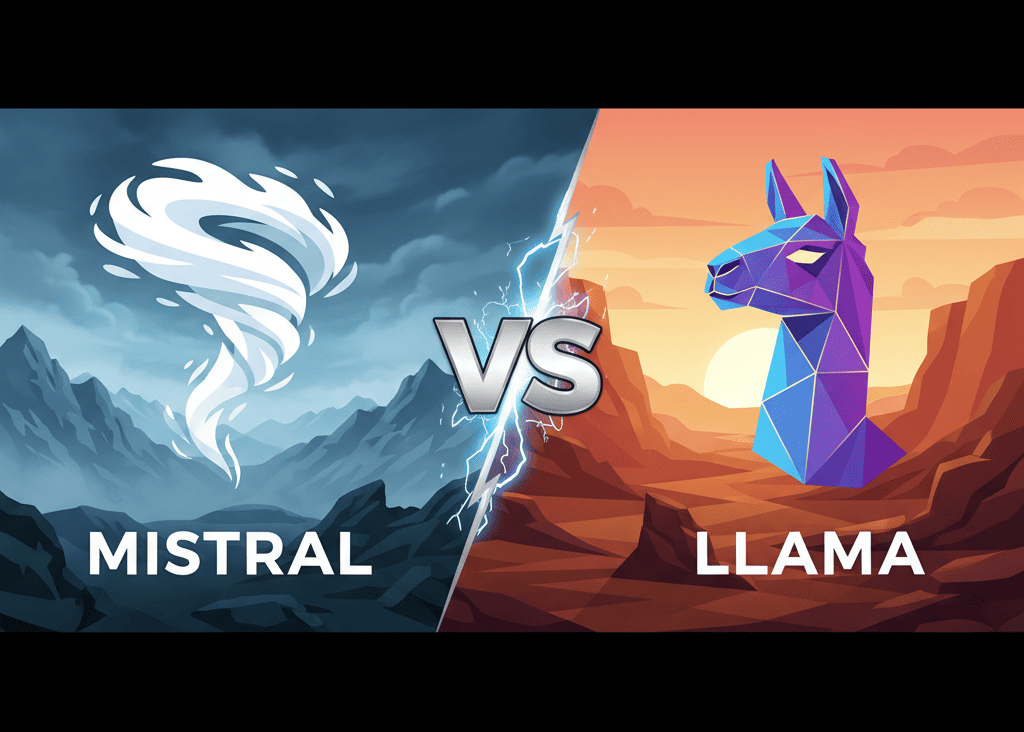
Choosing the right open-source Large Language Model (LLM) is a crucial decision for developers and businesses building AI applications. The landscape is moving incredibly fast, and two of the biggest names in this space are Mistral vs LLaMA, which have very different approaches to AI.
While both models are a testament to the power of open innovation, their core design philosophies are distinct. Mistral focuses on efficiency and a smaller, highly performant architecture, while LLaMA, particularly with its LLaMA 4 models, is pushing the boundaries of scale and multimodality.
What is Mistral?
Mistral is a family of open-source LLMs built by the French company Mistral AI. Its models are renowned for their exceptional performance-to-size ratio. They achieve impressive results on benchmarks while being significantly smaller and more resource-efficient than their competitors, thanks to advanced architectural optimizations like Grouped-Query Attention (GQA).
The core strength of Mistral is its efficiency, making it the ideal choice for developers and companies who need to deploy AI on a budget or in resource-constrained environments. Mistral models are perfect for tasks requiring low latency, such as real-time chatbots, or for on-device and edge deployment where computational power is limited.
What is LLaMA?
LLaMA, developed by Meta AI, is a series of open-source large language models. The latest LLaMA 4 models are leading the industry in scale and capabilities, with versions offering unprecedented long context windows and native multimodality. LLaMA is a powerful, general-purpose LLM designed for a wide range of complex tasks.
The main purpose of LLaMA is to provide a highly scalable, versatile, and powerful foundation for a diverse set of AI applications. The LLaMA 4 models, in particular, are at the forefront of AI research, excelling in areas like long document analysis, code generation, and complex reasoning. Its open-source nature and robust performance make it a go-to for academic research and large-scale enterprise solutions.
Conclusion: Mistral vs LLaMA
In summary, Mistral is the superior choice for those who prioritize efficiency, speed, and cost-effective deployment. Its compact models deliver strong performance without requiring significant computational resources. LLaMA is the better option for developers and researchers who need a powerful, highly scalable, and versatile foundation for complex, large-scale applications. The best model for you depends on whether you value Mistral’s resource efficiency or LLaMA’s raw power and advanced capabilities.
FAQs
- Which model is easier to run on my computer?
Mistral models, particularly the smaller versions like Mistral 7B, are generally easier to run on consumer-grade hardware. LLaMA models, especially the larger versions from LLaMA 4, require more powerful GPUs and significant VRAM.
- Which is better for code generation?
LLaMA is often considered a stronger choice for code generation. Its larger models and training on extensive coding datasets result in more accurate and robust code outputs, although Mistral is still a very capable option for light development tasks.
- Is one of them truly “open-source” with a better license?
Mistral models are generally released under the Apache 2.0 license, which is a very permissive commercial license. LLaMA models, while open, come with a more restrictive license from Meta that may have usage limitations for large enterprises.
- Which model is faster?
Mistral models are known for their fast inference speeds. Their efficient architecture allows for quicker time-to-first-token and higher token throughput, making them ideal for low-latency applications like real-time chatbots.
- What is the difference between a dense and a Mixture-of-Experts (MoE) model?
A dense model uses all of its parameters for every task, while a Mixture-of-Experts (MoE) model only activates a subset of its parameters for a given task. MoE models like Mixtral can be very efficient, as they offer the power of a large model with the speed of a smaller one.
- Which model is better for multilingual applications?
LLaMA 4 has been pre-trained and fine-tuned for unrivaled text understanding across more than a dozen languages, making it a powerful tool for multilingual tasks. While Mistral also has good multilingual capabilities, LLaMA has a broader focus.
- Can these models be used for multimodal tasks, like image understanding?
LLaMA 4 models are natively multimodal, meaning they can understand both text and images. While Mistral has also released multimodal models, LLaMA’s native integration of vision capabilities is a key feature.
- Which model is a better choice for an academic researcher?
LLaMA is often preferred by academic researchers due to its scalability and the breadth of its capabilities, which are well-suited for a wide range of research projects. The LLaMA ecosystem also has a large and active research community.
- What about long context windows?
LLaMA 4 models offer an unparalleled long context window, with some versions supporting up to 10M tokens. This makes LLaMA an industry leader in processing and understanding long documents and conversations.
- Do they have a chat assistant version?
Yes, both Mistral and LLaMA have chat-optimized versions. These models are fine-tuned for conversational use cases and are often the best choice for building chatbots and virtual assistants.